High security · Norfolk County
Safe Installation & Servicing
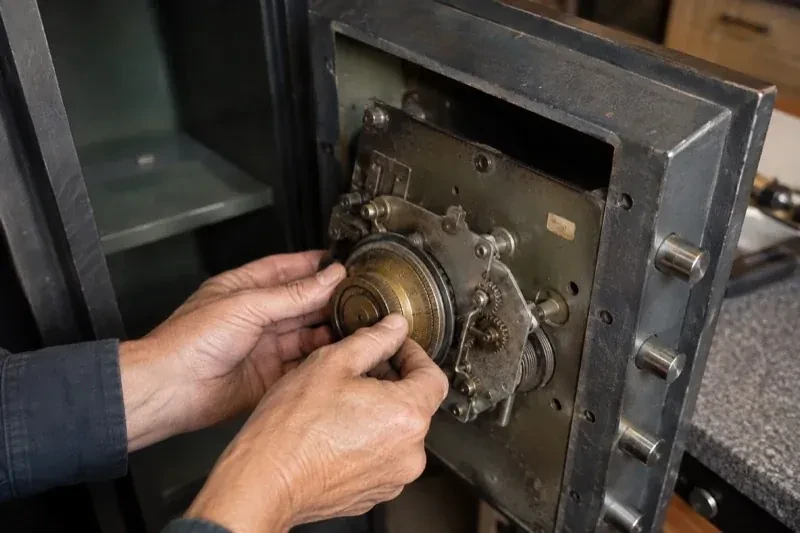
A homeowner inherited a heavy old dial safe from a parent's house, moved it into the new place, and has no idea whether the bolt-work still works, whether the lock is sound, or how it should be anchored.
In plain words
Businesses call for this service for two different reasons that sometimes overlap: protecting cash held overnight, and protecting paper records that would be enormously slow to recreate. The two priorities point toward different construction, since a cash-rated body resists tools while a document-rated interior resists heat and holds its temperature down through a timed fire test. Servicing an existing unit follows the same split: bolt-work and lock mechanics get physical attention, while any fire-rated lining is checked for the trapped moisture that builds up behind an airtight seal.
How the visit goesThe accountant's office keeps a decade of client files in cardboard boxes because the only safe in the building is a small drawer safe meant for a laptop, nowhere near large enough for binders of paper.
Safe Installation & Servicing
How the visit goes
Where the safe will actually be used, not just placed
A safe tucked into a spot nobody can reach easily gets used less often than intended, and one left in plain view of every visitor invites attention it does not need. The locksmith talks through how often the safe will be opened, by how many people, and at what time of day, since a till safe opened every hour wants a different position than a document safe opened twice a year. Concealment behind a panel or inside a closet is weighed against how practical daily access needs to stay.
Fitting and setting the lock
A mechanical dial lock is installed and set to a combination chosen privately by the owner, then run through a full sequence of locking and unlocking several times before anyone calls the job finished. An electronic keypad is programmed with a new code, its low-battery warning is tested rather than assumed to work, and any secondary user codes the owner wants are added at the same time. Where a hidden mechanical override sits behind the keypad, its key is handed over separately and its location explained.
Paperwork worth keeping somewhere other than inside the safe
The model number, the burglary and fire ratings, and a note of how and where the unit was anchored are all details worth keeping on file, ideally somewhere other than locked inside the safe itself. An insurer asking about coverage for cash or valuables will often want exactly this information, and having it ready saves a search through old boxes later. A few photographs taken during installation, showing the anchoring and the rating label, cover most of what gets asked for afterward.
Safe Installation & Servicing
In the van
Wood subfloor lag bolts and washers
Mechanical or electronic lock
Torque wrench and socket set
Nine-volt backup battery
Rated safe (burglary and fire)
Safe Installation & Servicing
What affects the quote
Floor or wall construction
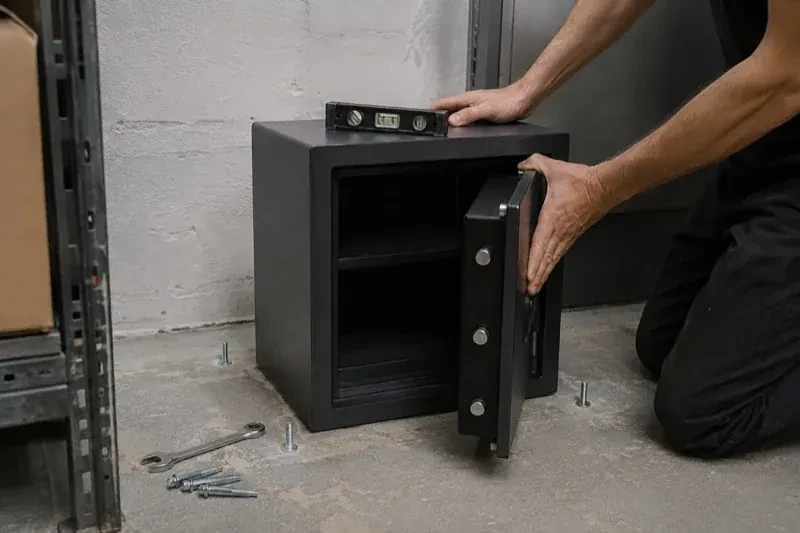
Solid concrete, a wood subfloor reaching into joists, and tile each call for a different anchoring approach and different hardware, and the substrate is confirmed before any drilling begins.
An insurer's or head office's stated requirement
Some businesses are told by a policy or a head office exactly what rating a safe on the premises needs to meet, which narrows the choice of unit before other factors are weighed.
Size and weight of the safe
A larger, heavier unit needs more capable moving equipment and more time to position safely than a compact document safe, which shows up in the labour involved rather than the hardware itself.
What to have ready
- Which room or level of the building will it go in?
- Has the safe ever been anchored to the floor or wall before?
- What floor or wall will the safe sit against?
Safe Installation & Servicing: questions
QuestionsWhy does the inside of my fireproof safe feel damp?
A fire-rated interior works by sealing tightly, and that same seal traps ordinary household humidity over time with nowhere to go. Opening the door for a few hours every few weeks lets trapped air exchange with the room, and a desiccant packet inside absorbs moisture between those openings if it is refreshed on schedule. A musty smell or a soft-feeling document is the interior telling you it needs airing out.
Can the combination or code be changed after installation?
Yes, on both mechanical and electronic locks. A mechanical dial is reset to a new combination by working inside the lock body, while an electronic keypad is simply reprogrammed at the keypad or through its service menu. Changing it after a change in staff, a move, or simply out of caution is routine work rather than anything unusual, and it can be arranged as its own visit.
How often does the battery need replacing on an electronic lock?
Most electronic locks give a low-battery warning, usually a beep or flashing light, well before they actually stop working, and replacing the battery within that same week is the safer habit rather than waiting. Depending on how often the safe is opened, a battery commonly lasts somewhere between one and several years, and keeping a spare of the correct type near the safe avoids a search once the warning starts.